sosie
Linux on a RISC-V machine written in machin. It boots natively, under Node and in a browser.
Linux on a RISC-V machine written in machin. It boots natively, under Node and in a browser.
Experimental. Only headless Chrome and Node on Linux x86-64 were tested. There is no internet access from the guest. The browser's saved disk is not a backup. The live demo runs at sosie.intrane.fr.
first of two machines, after the second ran passwd and dropbear -R (output shortened)
Network: this machine is 10.0.0.1.
Welcome to Linux on sosie.
~ # ping -c 3 10.0.0.2
3 packets transmitted, 3 packets received, 0% packet loss
~ # ssh root@10.0.0.2
(host key question and password prompt)
~ # hostname
sosie2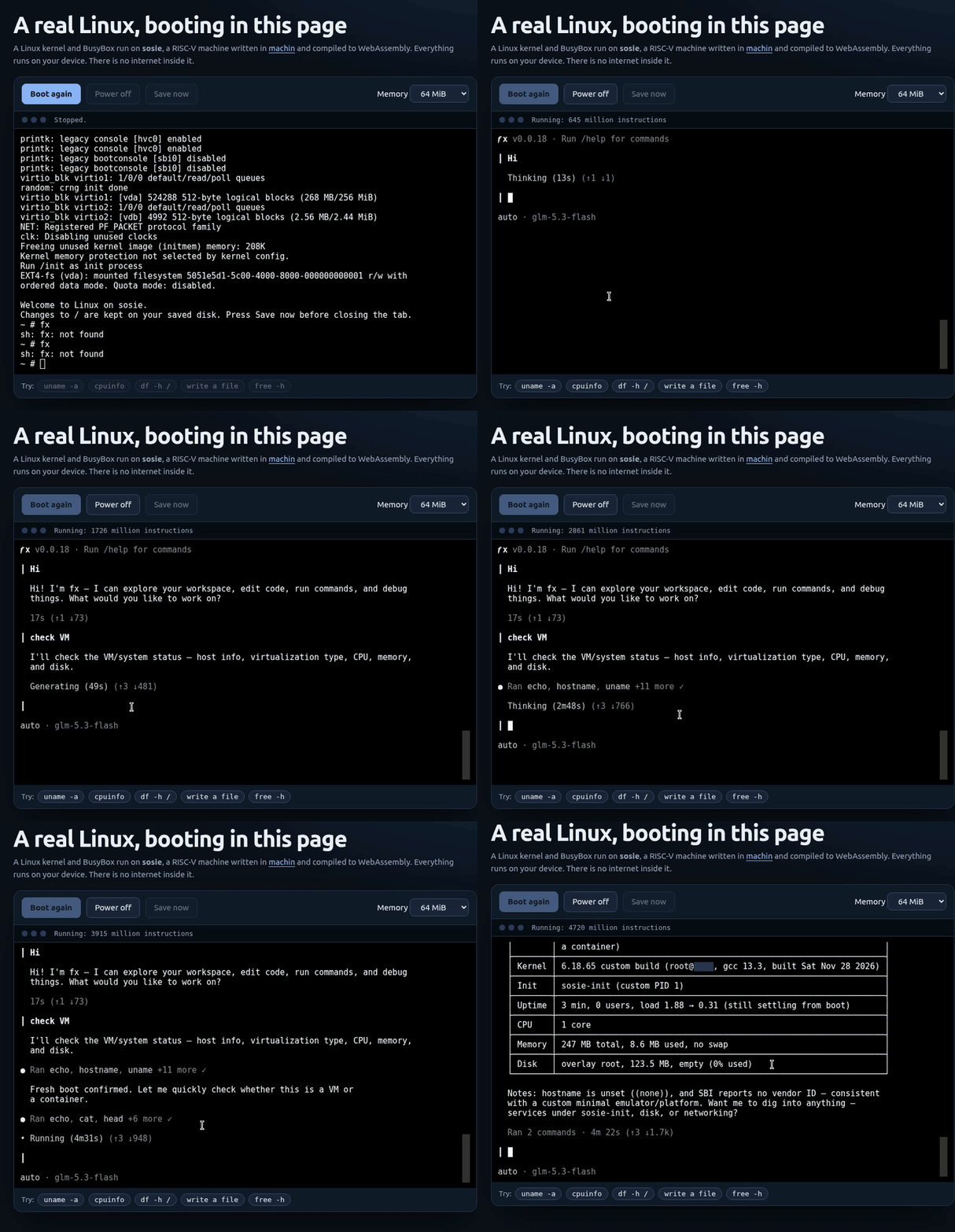
glm-5.3-flash through the page (recorded on a local build). To try it, open the demo in its own tab, tick fx agent, enter your own OpenRouter key (you pay for its use; give it a low limit), boot, and type fx. Experimental. The model does not run in the machine, whose only way out is that model, and what the agent sends goes to the provider. Recording sped up 3×. Times shown in the terminal are the emulated machine's clock, which runs fast when it is busy. The kernel's build host name is blanked.| Works | Not built or not tested |
|---|---|
Saved / (256 MiB disk), safe mode, Save now, saved disks that open after a system-disk update |
Export and import, freeing space from deleted files, the 2 GB disk, upgrading a saved disk to a newer system |
| Ping, TCP and SSH between tabs of one browser | Internet access, other computers (no relay), apt |
| Headless Chrome and Node on Linux x86-64 | Firefox, Safari, phones, long-hidden tabs, speed of disk and network |
The source code is not public yet. Its public repository, javimosch/sosie, holds only these pages (MIT). File paths, build steps and test commands in them refer to the private source.
The demo contains the Linux kernel and BusyBox (GPL-2.0). Their source, configuration and build scripts are offered beside it, with the Dropbear, musl and xterm.js notices. That page also gives the licence of the emulator the demo ships (MIT).