Measured, not asserted
The same programs, written idiomatically in each language — all runnable under bench/ in the repo.
1 · As cheap for an agent to write as Python. Tokens to author the same REST+SQLite API (tiktoken o200k):
| language | author tokens | ships as |
|---|
| machin | 388 | 44 KB native binary, 0 deps |
| Python | 383 (0.99×) | source + a CPython interpreter |
| Go | 527 (1.36×) | 14.8 MB binary + a module dep |
2 · Native-tier fast. Four kernels, byte-identical output, each at its best release setting (min of 5):
| kernel | machin | Rust -O3 | Zig |
|---|
| fib(40) | 245 ms | 303 | 306 |
| mandelbrot 1000² | 827 | 814 | 819 |
| sieve 10⁷ | 203 | 153 | 145 |
| intsum 10⁹ | 2832 ms | 3764 | 3556 |
It's C underneath — wins scalar recursion + integer loops, ties float, trails ~1.4× on array-heavy code. In the same tier as Rust/Zig; not "faster than Rust".
3 · Ships like nothing in the scripting world. Same HTTP server, deployed:
| same server | image | cold start | idle RAM |
|---|
| machin (static, FROM scratch) | 92.9 kB | 0.49 ms | 108 kB |
| Python (py + alpine) | 47.6 MB · 512× | 49 ms · 100× | 17.9 MB · 166× |
| Node (js + alpine) | 178 MB · 1916× | 29 ms · 59× | 51 MB · 477× |
A 92.9 kB image, ready in half a millisecond, on ~0.1 MB of RAM. scp one file to a $4 VPS.
Try it (~60 seconds)
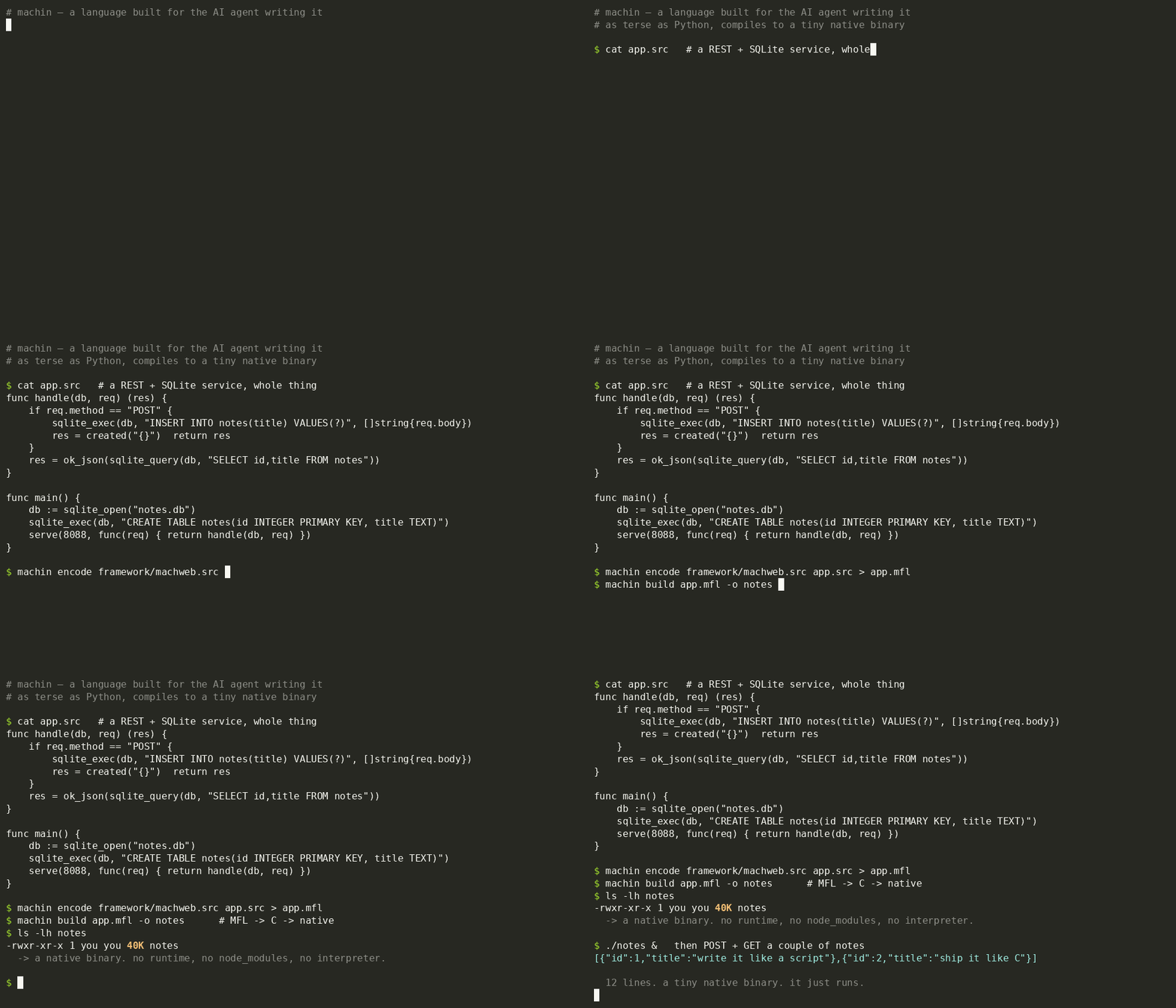
curl -fsSL https://raw.githubusercontent.com/javimosch/machin/main/install.sh | sh
machin guide                                # the whole language, version-exact, as JSON

# write app.src (a REST+SQLite service), then:
machin encode framework/machweb.src app.src > app.mfl   # framework ships in the binary
machin build --static app.mfl -o app                    # static (musl) → FROM scratch
./app
Building programs needs a C compiler. machin build <file> --emit-c prints the C the compiler generated.
Batteries included — pure MFL, one binary
HTTP + router
machweb: a native server, JSON, cookies, signed sessions, SSO, SSE, WebSockets.
Databases
SQLite built in (bundled with --static); pure-MFL Postgres / MySQL / Redis / Mongo drivers, pooled.
Concurrency
goroutines, channels, select; a per-goroutine arena plus scoped arena{ } blocks that bound a long-lived loop's memory.
Closures
func literals capture by reference — mutable state across calls, the counter idiom, no boilerplate.
--safe mode
opt-in bounds, div-zero, and overflow checks for when you want guardrails over raw speed.
Crypto
SHA-256, HMAC, HKDF, Ed25519, X25519, AES-GCM — binary and text paths.
Frontend & games
a reactive WebAssembly UI target; raylib GUI/audio/3D via C FFI.
One artifact
compiles to a single native binary — no Node, no interpreter, no runtime.
Built with it
machin-hook — a self-hosted webhook relay + live inspector (webhook.site + smee.io in one binary): capture any request, watch it land live over SSE, replay or forward it. ~330 lines of MFL. The curated list of tools is awesome-machin.